Fish Pond Liner Cost per Square Meter: Material, Welding and Shipping
-

- 26th novembre 2026

Fish pond liner cost per square meter depends on the material specification, purchased area, welding scope and delivery location. A useful budget starts with the liner purchase, adds transport and installation charges, then divides the total by a clearly defined area. Every quotation needs those boundaries before its unit price becomes comparable.
For a commercial fish farm, ask for three figures: the material price per purchased square meter, the cost delivered to the site, and the installed lining budget. The example below shows how to calculate them using hypothetical inputs. Actual prices require a dated quotation for your project and destination.
What Does a Fish Pond Liner Quote per Square Meter Include?
Material-only, delivered and installed prices
Ask each supplier to identify the delivery point and included work. A quotation for CHANGFENG smooth HDPE geomembrane can then be compared against the same material and scope from another supplier.
| Budget level | What to establish | Items to check separately |
| Material purchase | Specification, purchased area and packing | Freight, installation and testing |
| Delivered to site | Material plus the agreed transport chain | Import charges, unloading and any excluded handling |
| Installed lining | Delivered material plus defined installation work | Earthworks, protection layers, drainage and other exclusions |
Write down the exclusions beside each total. This prevents a low material price from being compared directly with an offer that includes installation.
Purchased area, lined surface area and water footprint
Keep these measurements separate:
- Purchased liner area:the total sheet area ordered, including material used in overlaps, anchoring and cutting allowances.
- Net lined surface area:the pond surface covered, including its bottom and slopes, with overlaps counted once.
- Water footprint:the horizontal water surface area at a stated operating level.
Use purchased area when comparing material prices. Use the same measured lined surface area when comparing installed budgets. Label either calculation explicitly; the two figures answer different questions.

How Material and Thickness Affect Liner Cost
HDPE and other liner materials: compare the same specification
An HDPE pond liner price is comparable only when the offers specify equivalent products. Record the polymer, thickness, surface finish, roll dimensions and required quality documents. EPDM, PVC and reinforced liners need their own specification and joining assessment; this guide’s thermal welding discussion concerns suitable polyethylene systems.
For aquaculture, request evidence of suitability for the intended fish and water conditions. A material name or a general waterproofing claim alone does not establish that suitability.
Thickness, resin specification and documented quality
At equal area and density, increasing sheet thickness increases material mass. However, a supplier’s selling price also reflects the formulation, order quantity, testing and production requirements. Confirm the specified thickness and its permitted tolerance.
Ask for a technical data sheet and the applicable batch test documentation. Have the project designer determine the required performance from the subgrade, exposure, handling and operating conditions. Thickness alone cannot establish puncture performance or service life.
Roll dimensions, panel layout and usable coverage
Request a panel layout before choosing roll width. Wider sheets may reduce field seams, but the delivery route, unloading equipment and installation crew must be able to handle them. Compare the resulting purchased area and seam length for each proposed layout.
For protection layers, assess the prepared surface and the specified lining system. If the design includes protective geotextile, budget its supply and installation separately. Its area and overlap requirements may differ from the geomembrane’s.
How to Choose the Right Thickness for a Fish Pond Liner?
Choose thickness from the pond design and operating conditions, then compare the cost of compliant options. CHANGFENG’s supplied product table lists nominal thicknesses of 0.75, 1.0, 1.5 and 2.0 mm. These are specification options to discuss with the supplier; availability and suitability require confirmation for each project.
Assess the pond and its maintenance conditions
Give the designer the pond depth, slope geometry and subgrade condition. Identify sharp particles, potential settlement, exposed edges and places where cleaning equipment or workers may contact the sheet. Include pipe connections and the planned anchoring arrangement in the review.
A thickness decision should accompany a prepared-subgrade and protection-layer design. Increasing sheet thickness alone cannot resolve an unsuitable base or an unsupported detail.
Compare performance and total installed cost
Ask the designer to specify the minimum thickness, permitted tolerance and required mechanical properties. Request matching test data, including puncture resistance and stress-crack resistance where the project specification requires them. Check that the proposed welding equipment and procedures suit the selected sheet.
Then compare material, handling, protection and installation costs for the acceptable options. For example, at equal area and density, a 1.5 mm sheet has 50% more material mass than a 1.0 mm sheet. That calculation does not establish a 50% increase in selling price or a proportional increase in service life.
Have the designer approve the final thickness and lining details before ordering. Pool depth alone is insufficient to select a universal thickness for every fish farm.
How to Calculate the Liner Area You Need to Buy
Include pond slopes, anchoring and seam overlaps
Start with the surveyed bottom dimensions and slope geometry. Measure the actual slope lengths, then account for the anchor detail, pipe penetrations and panel overlaps. A drawing showing only the pond’s water-surface length and width is insufficient for a purchase calculation.
For an irregular pond, use the surveyed surface model or measured cross-sections. For a simple pond, a dimensioned bottom-and-slope drawing can support the takeoff. In either case, confirm the layout with the installer before ordering.
Separate layout waste from covered surface area
Use this purchasing relationship:
Purchased area = net lined surface + anchoring allowance + overlap allowance + layout offcuts + agreed spare material.
Keep the categories separate so an allowance is counted once. Avoid adding a general waste percentage after a detailed takeoff has already included the same overlaps and cuts. Retain spare material as its own budget line if it is intended for future repairs.
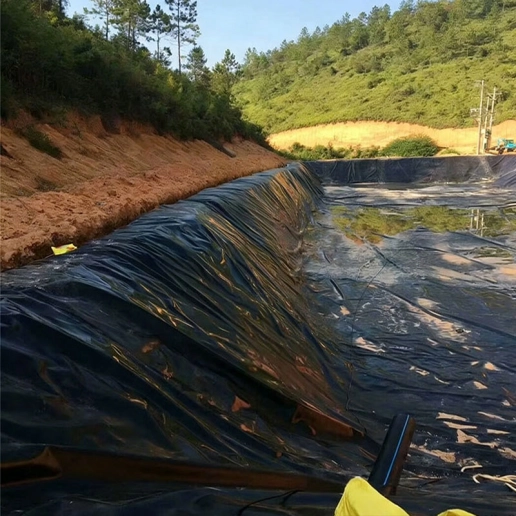
What Goes into Pond Liner Welding Cost?
Seam length, mobilization and site access
Pond liner welding cost may include a fixed mobilization charge and a rate per linear meter of seam. Ask the installer to state both the quantity and the unit. A square-meter installation rate should identify the panel layout and work included.
Access, power supply, weather delays and accommodation can change the quotation. Clarify who supplies lifting equipment and who prepares the surface before the crew arrives. For multiple ponds, ask whether one mobilization covers the full installation schedule.
Welding, penetrations, testing and repairs
Obtain separate allowances for straight seams, detail work around pipes, patches and testing. Agree on trial welds, inspection records, acceptance criteria and responsibility for repairs before installation begins.
The project specification should identify the applicable seam requirements. The Geosynthetic Institute specification index lists GRI-GM19a for thermally bonded homogeneous polyolefin geomembrane seams. Confirm the relevant edition and material scope with the project engineer. Obtain welding rates separately from the installer.
How Shipping Changes the Delivered Cost per Square Meter
Roll weight, package dimensions and container utilization
Ask for a packing list showing roll count, dimensions, gross weight and loading arrangement. The forwarder needs those details and the destination to quote transport. Purchased square meters alone do not describe the shipment.
Calculate allocated freight per square meter as:
Freight per purchased m² = freight allocated to the liner shipment ÷ purchased liner area.
If the container also carries geotextile or other products, agree how freight is allocated. Keep that method consistent across offers, and confirm the quotation’s validity period and excluded surcharges.
Match freight and destination charges to the quoted trade term
CIF includes seller-arranged freight and insurance to the named destination port, while the buyer handles import formalities. Under CIF, risk transfers when the goods are loaded aboard at shipment. These boundaries are explained in ICC Academy’s guide to CIF and CIP under Incoterms® 2020.
Consequently, build the site-delivery budget from the named port onward as well. Check customs brokerage, duties and taxes, terminal charges, inland haulage and unloading. Confirm which charges the freight contract already includes to prevent double counting.
For containerized or multimodal movements, agree the appropriate rule and named place with the supplier and forwarder. Record the Incoterms version in the quotation.
A Worked Budget Example with a Consistent Area Basis
Build a line-item budget from explicit assumptions
Illustration only: every quantity and rate below is hypothetical, prepared for this guide on November 18, 2026. These USD teaching inputs have no destination country assigned. They do not represent market prices or a CHANGFENG quotation.
Assume 1,000 m² purchased liner covers 850 m² of net pond surface. The remaining 150 m² represents the assumed anchoring, overlap and layout allowances. The installation estimate assumes 300 linear meters of field seams.
| Article | Hypothetical basis | Amount (USD) |
| Liner material | 1,000 m² × $2.00/m² | $2,000 |
| Origin handling, freight and insurance | Separate allowance, charged once | $600 |
| Destination handling, inland haulage and unloading | Separate allowance | $400 |
| Import duties, taxes and brokerage | Unconfirmed destination-dependent amount | T |
| Installer mobilization | Fixed allowance | $300 |
| Field welding | 300 linear m × $1.00/m | $300 |
| Detail work and seam testing | Separate allowance | $200 |
The resulting calculations are:
- Delivered material subtotal:$3,000 + T.
- Delivered cost per purchased m²:$3.00 + T/1,000.
- Material plus specified installation:$3,800 + T.
- Cost per net lined m²:($3,800 + T)/850, approximately $4.47 + T/850.
These totals exclude earthworks, protection layers, drainage and operating equipment. The unknown amount T remains payable as applicable; it has not been assumed to be zero. Replace every input with confirmed project quantities and quotations before budgeting a purchase.
Compare two quotes using the same denominator
Suppose a second offer reduces only the material rate from $2.00 to $1.90/m². At the same 1,000 m² quantity, that reduces the material subtotal by $100, before any resulting change in taxes or other charges.
Now suppose only the freight allowance rises by $200. That adds $0.20 per purchased m², or approximately $0.24 per net lined m². Keeping the quantities and denominator fixed makes the effect of each change visible.
Why Choose CHANGFENG HDPE Fish Pond Liner?
CHANGFENG supplies smooth HDPE geomembrane for water containment and aquaculture applications. Its product materials describe specification customization and technical support, giving buyers a starting point for matching a liner order to the pond design.
For a fish pond liner purchase, discuss these requirements with CHANGFENG:
- Material selection:specify virgin HDPE and request the formulation declaration and supporting quality documents for the proposed product. Confirm aquaculture suitability for the intended operating conditions.
- Roll planning:ask which thicknesses and roll dimensions are available for the order, then compare the proposed panel layouts and field seam quantities.
- Installation coordination:discuss product selection and installation guidance, and confirm who will perform and test the field welds. On-site services need an agreed scope.
- Export quotation:request the packing details, delivery term and transport charges needed to calculate the delivered cost per square meter.
Evaluate the offer against the approved specification and the documents supplied with it. Confirm production timing, warranty conditions and service responsibilities in writing before placing the order.
What to Send for an Itemized Pond Liner Quote
Send a single RFQ package to each supplier:
- Project country, destination port and final site address.
- Pond drawings, bottom dimensions, slope profiles and operating water depth.
- Required polymer, thickness, quality documentation and aquaculture suitability evidence.
- Preliminary takeoff, roll-handling limits and requested spare material.
- Installation scope, estimated seam length, penetrations and testing responsibilities.
- Delivery term, named place, currency, packing requirements and quotation validity.
- Required schedule and separate confirmation of duties, taxes and unloading.
Ask for a subtotal at each boundary: material purchase, delivery to site and the agreed installation scope. Contact CHANGFENG with these details to request an itemized fish pond liner quotation. Confirm product specifications, lead time and installation arrangements for the particular order.
Foire aux questions
Q1: Is pond liner priced by pond size or by purchased liner area?
Material quotations should state the purchased sheet area. A pond’s bottom and slopes determine its covered surface, while anchoring, overlaps and cutting allowances affect the order quantity. The horizontal water footprint is a separate measurement. Ask the supplier to show the quantity calculation behind the quotation.
Q2: Is virgin HDPE better than recycled HDPE for fish ponds?
For fish-contact applications, specify traceable virgin HDPE as a procurement preference. Leister’s aquaculture sealing guide recommends material without recycled content. Confirm formulation and suitability evidence for the finished liner: virgin resin alone does not prove fish safety, and recycled feedstock requires scrutiny of its origin and composition.
Q3: How long does an HDPE fish pond liner last?
Service life depends on formulation, temperature, exposure, installation and operating damage. GSI’s geomembrane lifetime paper distinguishes exposed and covered conditions and explains why formulation matters. Request a product-specific assessment and written warranty terms. Neither a generic year range nor a warranty alone establishes the pond’s actual operating life.
Q4: Can HDPE geomembrane be used for fish farming?
Yes. HDPE geomembrane can line fish-farming ponds when the selected product and installation suit the application. CHANGFENG lists aquaculture among its smooth geomembrane uses. Confirm the finished material’s suitability for fish contact, prepare the subgrade, and test seams before commissioning. Aeration, filtration and water-quality management still require their own design.
Q5: Does a liner quote include welding and seam testing?
Check the written scope. A material quotation may cover only the rolls and specified packing. Request separate confirmation of installer mobilization, seam quantities, detail work, testing and repair responsibilities. If installation is priced per square meter, confirm which area measurement and panel layout support that rate.

Améliorer les performances de l'énergie solaire.
Derniers projets, solutions et approvisionnements énergétiques
Synthetic Erosion Control Mat
Spiral Rigid Permeable Pipe
HDPE Corrugated Drainage Pipe
Anti Termite Barrier Membrane
Géomembrane texturée en PEHD
Géomembrane lisse en PEHD

Plus qu'un fabricant
Votre partenaire de solutions
Nous assurons la transition entre l'efficacité de la production directe et l'expertise en ingénierie. Que vous soyez confronté à des réglementations strictes ou à des conditions de chantier complexes, notre équipe vous apporte la force invisible dont votre projet a besoin grâce à une collaboration technique approfondie.

Collaboration d'experts

Autorité de l'usine

Solutions innovantes
Obtenez un devis